This guide covers the nitty gritty of collecting and producing video testimonials: from start to finish. We also include a prescription on how to set up an ongoing video testimonial program without much more time so that you have a repeatable process vs. a one-off project.
We'll cover the full process: choosing who to ask, requesting the video (and automating that request), writing the questions, recording, editing and branding, and finally publishing and distributing the result. If you want to go deeper on guidance for the actual recording, we've got a companion piece on how to shoot a video testimonial.
Step 1: Choose Who to Ask
Start with customers you already know are happy. You can find these people anywhere you already interact with customers: a five-star review, a warm reply to a renewal email, a thank-you in your support inbox, a champion who keeps referring you, a positive NPS score.
Don't be too picky. One of the most common mistakes we hear about from marketers is asking a single "perfect" customer for a video, and stalling when they go quiet. The process below is built to ask many people at once. You're only asking for 5 minutes of their time total, not a half-day video shoot. Clari went from "just a few" testimonial videos to 40+ in six months once they opened the aperture on video candidates, and NOCD produced 330+ employee videos in three months the same way.
Step 2: Request the Video (and Consider Automating It)
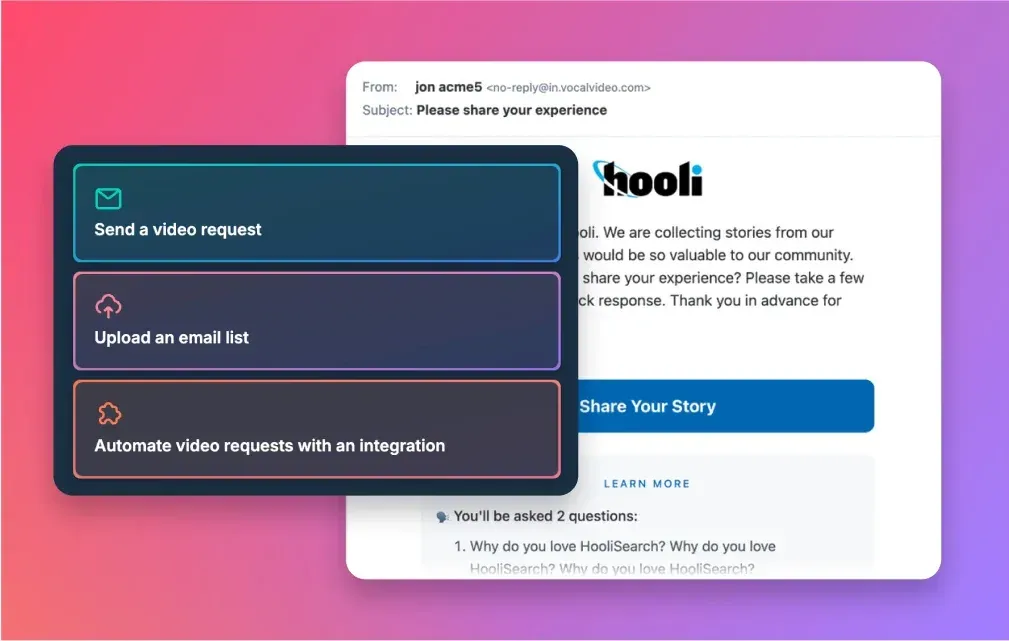
This is the step most guides skip, and it's the one that decides whether you end up with a library or a single video.
With Vocal Video, you get a link to a Video Collector that you can share in your own emails, or send a video request right through Vocal Video. Either way, your recipient clicks it, records on whatever device they're holding, and you get the video back. There's nothing for them to install and no meeting to schedule. You can request videos in four ways:
- From your own emails, texts or landing pages. Grab the Video Collector link and share how you'd like.
- From a list. Upload a CSV of customers and send the request to everyone at once — the fastest way to build a library.
- One-off. Fire a single request to one person when the moment is right, straight after a great call or a renewal.
- Triggered from your other apps. Connect Vocal Video to the tools you already use through 6,000+ apps via Zapier (HubSpot, Salesforce, Marketo, Klaviyo, and thousands more) or the API, so a closed-won deal in your CRM automatically triggers a testimonial request. The ask goes out the moment a customer is happiest, without anyone remembering to send it.
Every video request email includes the recording link and a few tips, and non-responders get an automatic reminder after seven days — no chasing on your part. Automating the outreach, not just the recording, is what keeps the videos coming in while you work on something else.
Step 3: Write the Questions
Specific and targeted questions help elicit the best things your customer has to say about your brand.
Keep it to a short, guided sequence — two to five questions is the sweet spot.
- Set the scene. "What problem were you trying to solve before you found us?"
- Show the turning point. "What made you choose us, and what changed after you did?"
- Land the result. "Would you recommend us?"
Ask about specifics, not adjectives. "How much time does this save your team each week?" pulls a concrete answer; "Do you like the product?" pulls a shrug. If you're not sure where to start, Vocal Video ships with dozens of expert-tested request templates you can adapt, so you're rarely writing from a blank page.
Step 4: Record It
Once your customer receives the Video Collector, they can record asynchronously — on their own time, on their own device, through the browser — there's no studio to book and no crew to hire. They get a built-in teleprompter if they want to pre-load a script, background blur for privacy, and unlimited retakes until they're happy.
That's the whole recording step from your side: you already sent the request, so now you wait for the video to come back. The craft of a great recording — lighting, framing, what to say and how to say it — deserves its own treatment, and we've written it up in how to shoot a video testimonial. For the end-to-end process, the thing to know is that this step no longer requires a camera operator, a conference room, or a shared calendar.
As Bill B. put it in a G2 review, finding the time and money to schedule shoots once "made video an expensive and infrequent tool" — and now "one just needs the same set up as a Zoom call."
Step 5: Edit and Brand the Video
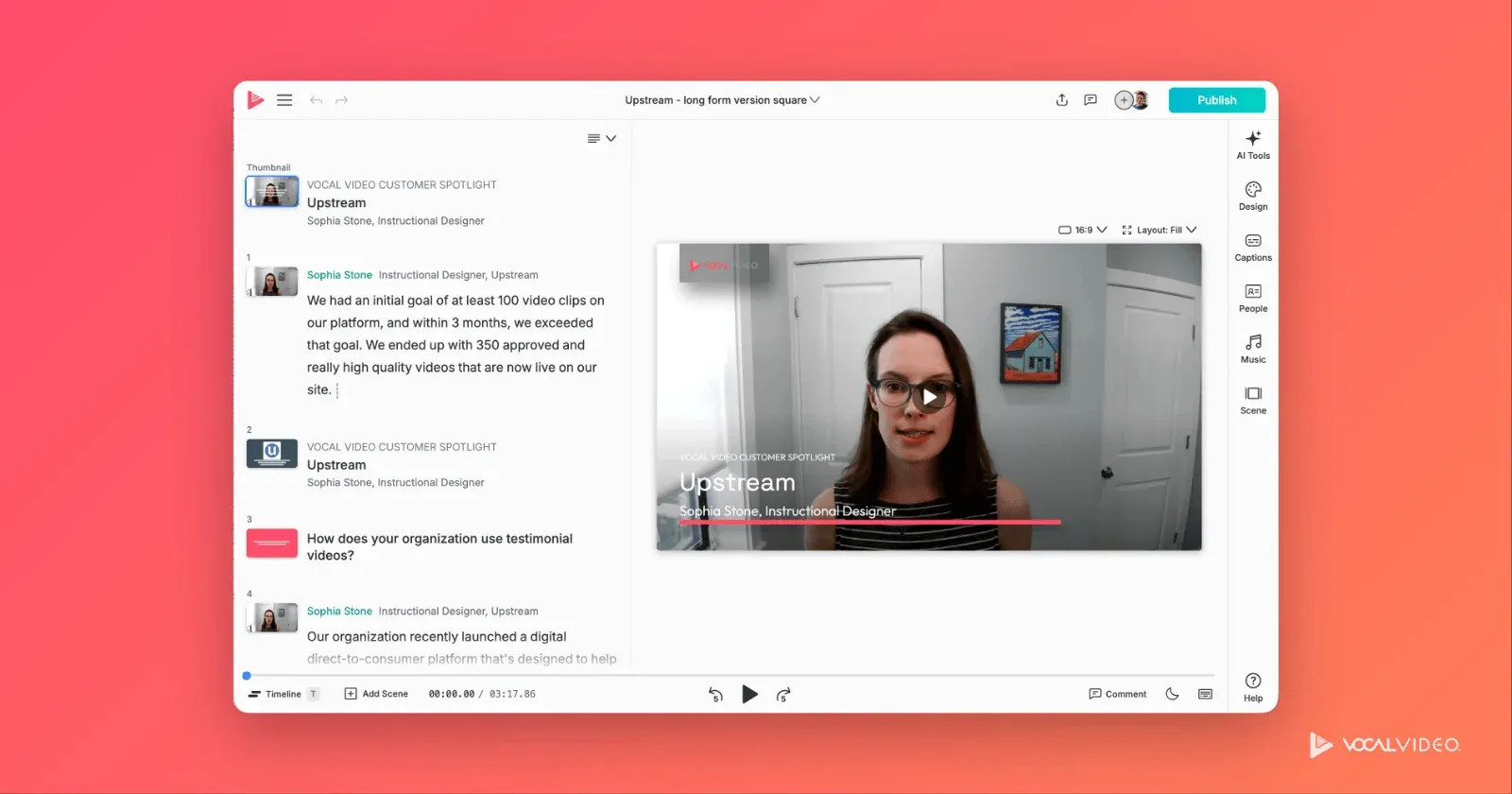
Raw footage isn't a testimonial yet. It needs to be trimmed, captioned, scored, and dressed in your brand before it's ready to share — and this is the step that historically ate weeks and required an editor. It's also where Vocal Video does something no other tool in the category does.
When a recording comes in, the Vocal Video 'automagically' turns it into a finished, branded video automatically: your logo and colors, subtitles, background music, transitions, and 1080p output, with no manual editing. What used to be a bottleneck happens on its own.
When you do want to shape a clip, you edit it by editing its words. Transcript-based editing lets you cut footage by deleting text, remove filler words and long silences in one click, and clean up the audio — no timeline scrubbing, no video skills. "I don't have to involve my video editor," says Ting Mei Chong, Advocacy Manager at Quadient. "I can edit and refine the videos all by myself and get them published in no time at all." One reviewer, Evan H., put the output plainly in his G2 review: it "looks like you spent $25k on each video with an agency."
Crucially, none of this fabricates anything. The AI produces the video — it never generates the person or the words. What the customer said is exactly what viewers hear. That's the line Vocal Video won't cross: real human, real story, AI aimed only at the production work.
Step 6: Publish and Distribute
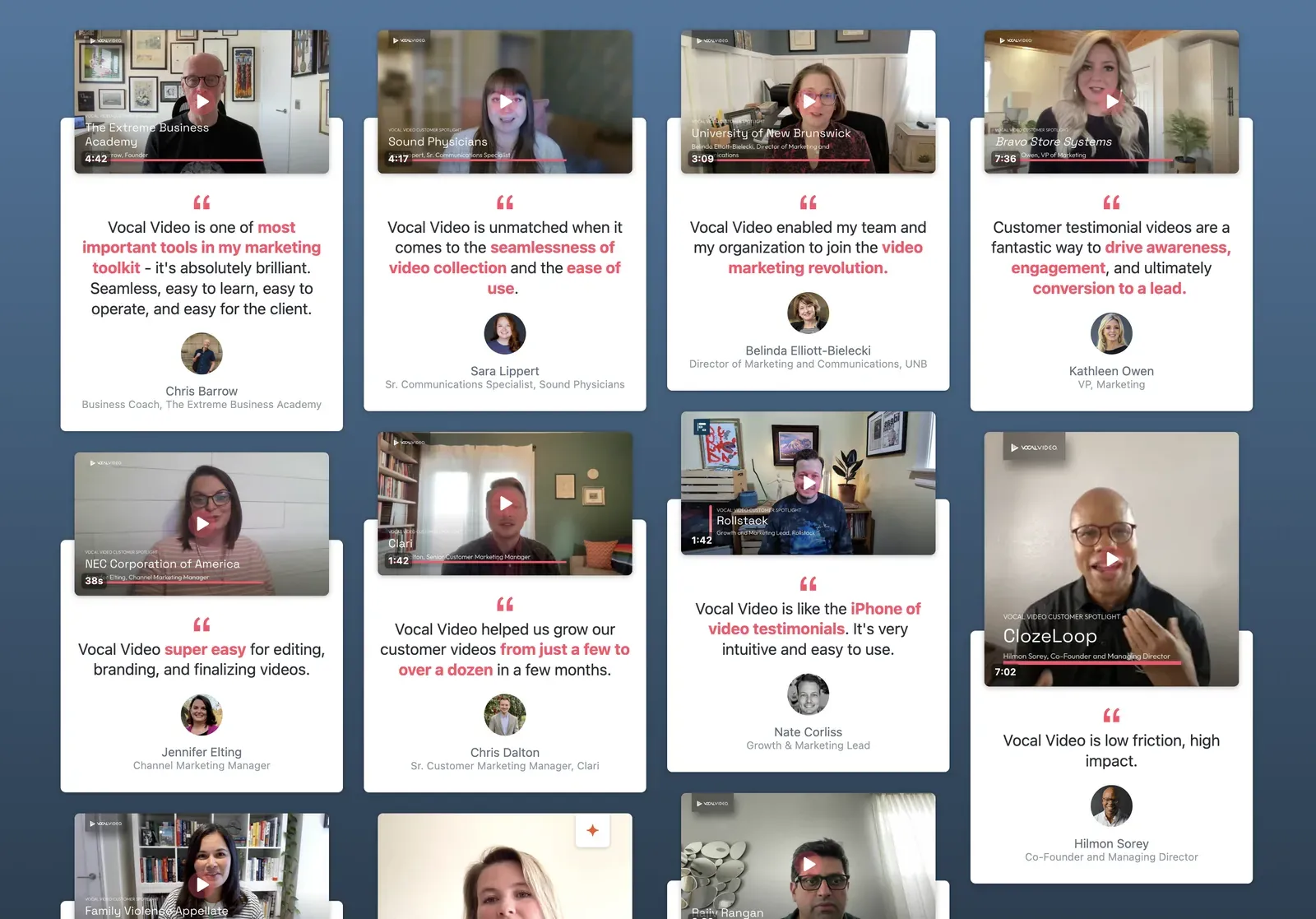
A finished testimonial that lives in a folder does nothing. The last step is getting it in front of the prospects it's meant to persuade — on your site, in your emails, wherever buyers are deciding.
Vocal Video hosts every video ad-free (no competitor's logo, no unrelated recommendations after it plays) and gives you three ways to put it to work:
- Embed a single video on a landing page or in a case study with a snippet of code.
- Build a gallery — a wall of love, a carousel, or a grid — that collects multiple testimonials in one on-brand block.
- Share a link or a video card in sales emails, so a rep can drop the right proof into the right conversation.
Because the whole thing runs on one platform — request, collect, edit, host, distribute — you're never exporting files between an outreach tool, an editor, and a host. The video that came in on Tuesday can be live on your homepage by Wednesday.
How Vocal Video Fits the Whole Process
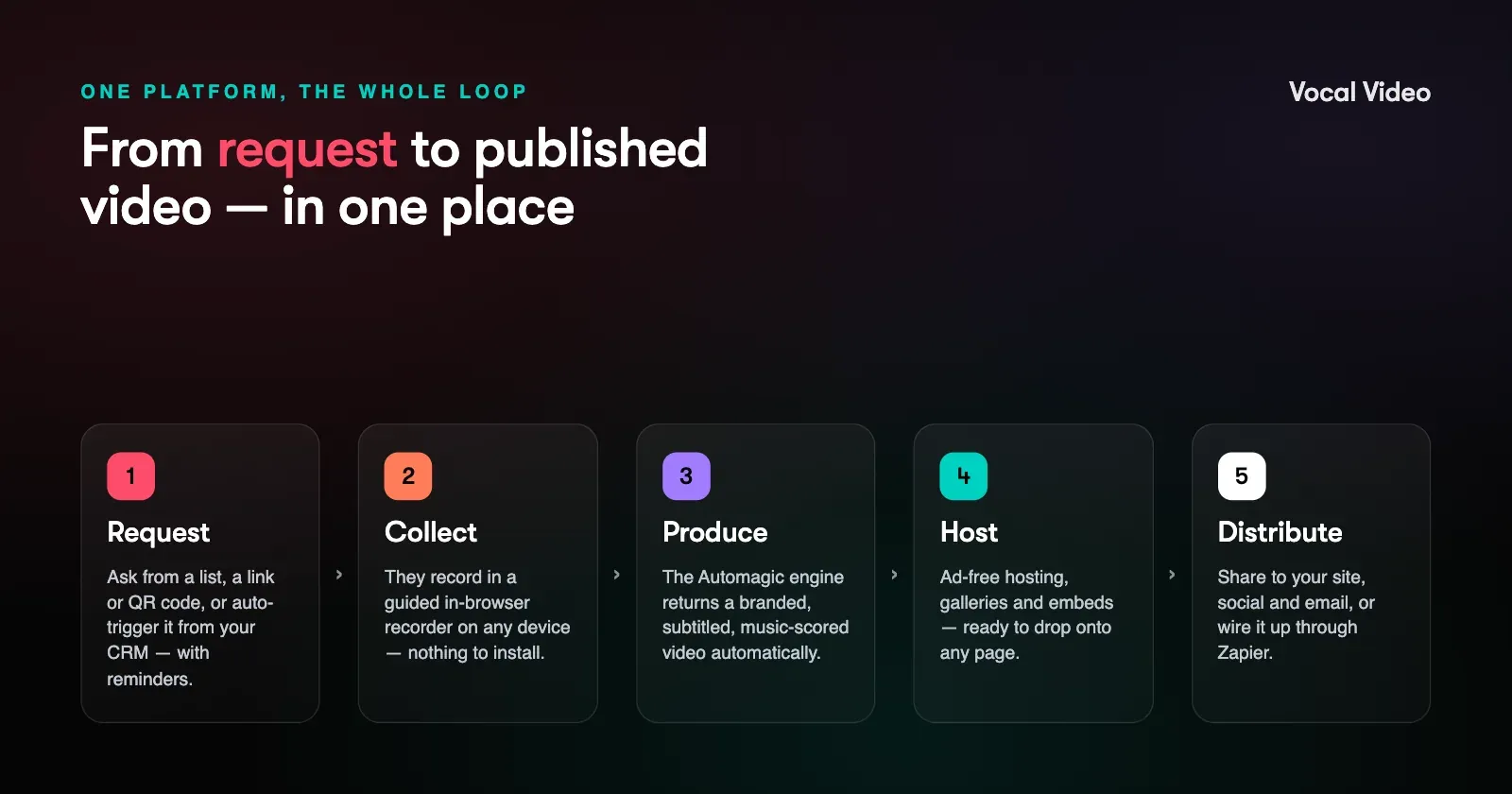
Vocal Video is the end-to-end platform for video social proof: you request the video (from a list, one-off, or triggered from your CRM), the customer records it in the browser, the Automagic editing turns it into a branded 1080p video, and you host and distribute it — all in one place, with no film crew and no editing background required.
That's why more than 25,000 companies — including Google, Cisco, Pfizer, and Honeywell — use it to build video proof at scale, why customers have recorded through Vocal Video collectors over 200,000 times, and why those videos have been watched over 450 million times. It's rated 4.8 on G2 and 5.0 on Google. For regulated teams, it carries ISO 27001 and ISO 27701 certification, a HIPAA BAA, GDPR and CCPA compliance, and the EU-U.S., UK Extension, and Swiss-U.S. Data Privacy Frameworks.
Frequently Asked Questions
How long should a video testimonial be?
Most effective video testimonials run between 30 seconds and two minutes. A short, tightly edited clip of 60 to 90 seconds tends to hold attention best on a landing page or in a social feed, while a longer version can work as a full customer story on a case-study page. The right length depends on where you'll use it — so it helps to collect a complete answer and then trim it down, rather than trying to force brevity during recording. Vocal Video's transcript-based editing makes that trimming a matter of deleting a few sentences of text.
How many questions should I ask?
Three to five questions is the sweet spot for most video testimonials. Enough to tell a story — the problem, the turning point, and the result — without overwhelming the person recording or producing an unusably long clip. Vocal Video guides the respondent through the questions one at a time, so a multi-question sequence still feels easy to answer, and you can start from one of its expert-tested request templates instead of writing prompts from scratch.
Do I need software to make a video testimonial?
You can technically make one with just a phone and a video editor, but software makes the process repeatable and removes the two hardest parts: chasing people for footage and editing it yourself. Vocal Video handles the full workflow — requesting, guided recording, automatic branded editing, and ad-free hosting — so a marketer with no video background can produce polished testimonials at scale. There's a free plan at $0 that lets you publish up to five videos with no credit card, and paid plans start at $99/month.
Ready to make your first video testimonial without a film crew or an editing background? Sign up for a free Vocal Video account — no credit card required — and send your first request today.